Showing posts with label Obama. Show all posts

May 27, 2013

WHO, WHERE AND WHEN U.S. DEMS/SOCIALISTS GOT ILLEGAL VOTING IDEAS?

  WHO, WHERE AND WHEN U.S. DEMS/SOCIALISTS GOT ILLEGAL VOTING IDEAS?
By, Michael Tobin
 By now, you just may be aware of this two-term administration and government entities such as IRS, public services agencies, schools, libraries, mainstream media etc..., activities during both Obama elections, such as official voting mail-outs instructing people on their mail-outs who and what to vote for. It's already acceptable for personal campaign offices to do that, but since when has tax dollars been able be used by agencies to do the same thing? Never thought of that? well that is what democrat-leaning public tax recipient organizations I've listed above actually do.
   But what about the voters/ Are you yet aware of the thousands of non-citizens bussed in this past election, all told to vote for Obama? How about the electronic voters votes being switched from their G.O.P. or conservative or libertarian votes, to Obama? Wow must've been a glitch?
   Well, are you aware during the early 1990's Bill Clinton's 1st and 2nd terms focused heavily in the Baltic areas? WHAT did they learn over there? here's what they learned, and guess who got the glee, joy and privilege to put this knowledge to use. You guessed it. Read this and weep.  

 http://latviansonline.com/commentary/article/8548/ 
May 26, 2013

Non-citizen voting in Latvian local elections

One of Russia’s foreign policy objectives in the former Soviet space is non-citizen voting in local elections. The upcoming Latvian municipal elections again put this issue on the front burner.
In the early 90’s, several international organizations (IO) designated the OSCE (Organisation for Security Cooperation in Europe) to recommend that Latvia grant non-citizens the right to vote in municipal elections.
Pressure also came from Russia, which uses the OSCE recommendation to harass Latvia to advance its geopolitical interests. The IO were motivated by several considerations: strengthening democracy in the new post-Soviet states, extending Western influence, and ensuring long-term stability in Eastern Europe. What concerns the IO most is ethnic conflict, as in Yugoslavia, and which see the solution in political participation.
The West emphasizes civil, social and political rights. The OSCE recommendation adds political rights for non-citizens. However, the principle of national sovereignty does not allow foreign countries to dictate citizenship standards to other states, resulting in a conflict between the OSCE recommendation, international convention and Latvia’s standard of political rights only with citizenship. The EU has no policy regarding non-citizen participation in local elections and only allows citizens of member states to do so.

Estonia’s Choice

Estonia adopted the OSCE recommendation for one reason. When restoring citizenship in 1991 on the principle of state continuity, Estonians were about 62% of the population, and with inclusion of pre-war minorities, citizenship rights were granted to around 68% of the population. The strict Estonian position on citizenship caused Soviet era migrants in the Narva region to threaten separation from Estonia when around 8% non-citizens adopted Russian citizenship. To prevent secession, Estonia expanded citizenship eligibility and adopted the OSCE recommendation, thus allowing non-citizens to vote every four years in local elections. However, they could not join or start a political party. This pleased the OSCE, but did not change Russian foreign policy towards Estonia.

Latvia’s Choice

Latvia did not accept the recommendation because there was no secessionist threat. Latvia sees political participation as a citizen’s prerogative. Neither the Latvian Constitution nor its laws permit voting for non-citizens. In 1991 the low proportion of Latvians raised concerns about a possible Soviet migrant takeover of power. The first Citizenship Act of 1993 highlights this concern. Heated debate with the IO forced a change in the law, and by 1998 it was modified, removing the citizenship window system and allowing all Latvian born children to obtain citizenship on an ius soli basis, thus increasing the number of citizens.

Definition of Non-citizens

Residents of a state consist of citizens, foreign nationals, the stateless and near-citizens. Foreign nationals are individuals who legally reside in or visit a country. Stateless persons have no citizenship whatsoever and legally reside in a country but without its diplomatic protection. Near-citizens, or in Latvia nepilsoņi, have civil, social, and partial political rights, including diplomatic protection from Latvia, that is, they are almost citizens. Countries that use this status can adapt it to meet its needs.
In Latvia, political rights of near-citizens include being up to half of all members in a political party. As party members, they can defend their interests by influencing all party activities. Allowing voting in municipal elections would give an additional political right.
Latvian near-citizens status was a compromise with the OSCE’s desire to involve the stateless in political decisions. Non-citizens make up around 13% of the population. Of all citizens, 72% are Latvians and 28% are minorities. Of the total population, from 2001 – 2011 minorities declined by 23%, Latvians by 6%, and near-citizens also decreased significantly. About one-third are of pensionable age. Non-citizen Latvian born minor children are entitled to citizenship as a parental decision.
Russia’s strategic goal is to create a Russian led Eurasian Economic Union. This strategy is seen in its diaspora policy, investment policy and initiation of the language referendum to make Russian Latvia’s second official language. Russia is not interested in minority integration into Latvian society, but manipulates human rights issues to exacerbate ethnic relations. Russia’s demand that Latvia grant citizenship automatically to non-citizens is absurd as this disputes the very legitimacy of the Latvian state.

Ideological Victory

With the collapse of the Soviet Union, the Cold and ideological wars were won by the West, affording a sense of superiority for its understanding of politics. The idea that pre-existing political models could be used in Eastern Europe without deeper analysis even though no historical precedent for such major change in a large area involving hundreds of millions of people existed is a consequence of this feeling of superiority. Western democratic interpretations became universally applicable. But if a political ideology is almost perfect, historical comparisons to it are unnecessary and potentially devastating. The consequence of the Soviet legacy is one such damaging criticism and thus is ignored. Years after the Soviet collapse, Western researchers realized the limitations of the pre-existing model approach. The OSCE recommendation was created in this ideological victory period.

Citizenship

Citizenship is never granted unconditionally. No country grants it to all who incidentally live in its territory. Citizenship implies a degree of exclusion: an open concept of citizenship is a contradiction. Citizenship is based on consanguinity (jus sanguinis) or territory (jus soli). Many countries use both, but none use jus soli exclusively. The Hague Convention on Nationality (1930), permits states to define its own citizens. The Convention, however, limits absolute freedom in deciding national citizenship: all inhabitants have a right to citizenship; states must avoid creating statelessness; no one shall be arbitrarily deprived of citizenship; a change in marital status should not affect the other partner’s nationality. Citizenship should serve as a basis for civil rights, political participation, social support, identity and that which serves the common good of society. The European Convention on Nationality (1997) tried to standardize EU member states nationality laws.
Assumptions about citizenship differ in Western and Eastern Europe. For Western countries, citizenship is associated with an individual’s legal obligations to the state and international law, grounded in civil, social and political rights, civil society, ‘shallow’ national culture and identity and, at least in theory, ethnic neutrality of the state, and monitoring the state applying abstract human rights standards.
Eastern Europe adds political will, a desire for ‘deep’ national cultural identity to the concept of citizenship. This desire for deep identity contrasts with the West’s shallow vision: it is hard to reconcile both views. Citizenship as a norm is not a neutral term as all countries saturate it with values, ideals and ideological significance.
Latvian citizenship tries to deal with the consequences of the Soviet legacy. Civic and national identities being weak, ethnic identity remained. Latvians assume their usual position as a minority which must be defended. Today, Soviet migrants must adjust themselves to minority status in a small country, not the war-winning plurality they had become accustomed to. In order to maintain their former status, migrants use Western minority and human rights rhetoric. Latvians must acclimatize themselves to majority status.
In 1941 Soviet authorities imposed unilaterally Soviet citizenship on Latvia, which is not recognized in international law. The Soviets granted citizenship to individuals on a request basis without naturalization requirements. However, this is how non-citizens often understand the citizenship acquisition process.
Latvia wants the security of loyalty. Offering political rights before showing loyalty does not offer security. Political rights without citizenship separate the responsibility for their actions expected of citizens. Responsibility required by law against anti-state activity cannot be demanded of foreigners or non-citizens. If citizenship is not included in one’s identity, there is no relationship between non-citizen’s political rights and his loyalty to the state.
Europe has shown that states are built on a core group, usually an ethnicity. In national consciousness the civic and ethnic, consciously or not, are closely related. Balts want to experience this form of national identity, to create a national consciousness from differing social and ethnic groups. Majority and minority cultures cannot play the same role in society. Promoting minority cultures has limitations. International and national agreements prohibit discrimination against individuals on ethnic, racial or other grounds. Minority group rights as groups are not internationally recognized, and are not in the UN human rights declaration. If group rights were to become an international standard, this would take away the legitimacy and sovereignty of states, dismantling the existing international framework, which is based on sovereign states. In 1995 the EU adopted the General Convention Protecting National Minorities recognizing several approaches to ethnic diversity, allowing states to choose their own path.

Necessary changes

The hoped for rapid democratisation of the post-Soviet space in the early 90’s did not materialize, for national development requires several generations. Western resistance to East European use of the same nation-building tools they themselves had used for centuries is illogical. New EU member states must be allowed to evolve and address nation-building challenges using the Western pattern.
It’s surprising how little violence there has been in the democratization process. Western assumptions that East European nationalism is based on ancient hatreds which the Soviet period froze creating a Pax Sovieticus, thus disallowing ethnic hatred to flourish is absurd.
Allowing non-citizens to vote or not vote in local elections puts Western and Latvian tenets at cross purposes. If political participation is an important principle for the OSCE, the Latvian political option offered to non-citizens meets these requirements. The OSCE recommendation should include them as acceptable standards of participation. The OSCE must also recognize the Soviet legacy as a legitimate historical experience and respect Baltic security concerns. The Eurocentric understanding of history, the ideological victory euphoria and bureaucratic inertia should be discarded. Unfortunately, the West is faced with a dilemma: to accept the Soviet legacy as legitimate would require taking some responsibility for the consequences of WWII up to 1991. This step the West is not yet ready to take.

March 14, 2013

What do the Vatican and Jesuits Have To Do With Hitler, Islam and Jerusalem?


What do the Vatican and Jesuits have To Do With Nazis, Islam and Jerusalem?
By, Michael D. Tobin March 14, 2013


***Oct. 18, 2013 UPDATE. THE FOLLOWING ARTICLE FROM TODAY'S THE WALL STREET JOURNAL, IS A TREMENDOUS CONFIRMATION TO THE PREVIOUS ARTICLES POSTED ON MARCH 14, 2013 Keep in mind that it's expedient for the Vatican to maintain a harsh treatment of Nazi WW2 war criminals; one, because Germany lost. And two, because Vatican must not admit publicly of their literal involvement with Adolf Hitler and plans for Hitler to hand over Jerusalem to the Vatican, which historians have submitted documents proving was their plan, should Germany win WW2 That information is also in a below article. Public history also proves Vatican concordats with Mussolini and Hitler during WW2. And three, because why should the Vatican involve itself with a side whose despicable and evil actions and plans are factually known and evident?***

***NOTE- all bold lettering are reference articles/sources, and non-bold lettering are my words***
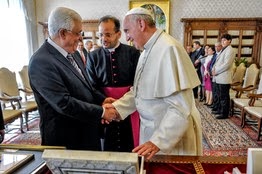
Pope Francis met Palestinian President Mahmud Abbas also known as Abu Mazen, during a private audience at the Vatican on Thursday. Poll Press


October 17, 2013 7:25 PM
Pope Plans to Visit Israel as Early as Next Year
Trip to Israel Would Come After Pontiff's Strong Condemnations of Anti-Semitism

http://online.wsj.com/news/articles/SB10001424052702303680404579141563422438386

 Six days after the death of former Nazi commander Erich Priebke, the furor over his b...
urial continues, with Italian and Vatican officials refusing a funeral. Priebke had been serving a life sentence in Italy when he died at age 100. (Photo: Getty)
By LIAM MOLONEY
ROME—Pope Francis plans to visit Israel as soon as next year, the Vatican said, in what could be a landmark visit for a pontiff who has already won plaudits from the Jewish community for his strong condemnation of anti-Semitism.
On Thursday, the pope also met at the Vatican with Palestinian President Mahmoud Abbas, who invited him to visit Palestine as well. Israeli President Shimon Peres had already extended an invitation to the pope to visit the Holy Land shortly after the pontiff's election in March.


Following the invitation from Mr. Abbas, "we can now start thinking in a more concrete way regarding the planning of the visit," said Vatican spokesman Rev. Federico Lombardi, adding that it could take place in 2014.
A papal trip to Israel and the Palestinian territories would follow in the footsteps of Pope Francis's predecessors, Benedict XVI and John Paul II. Both sought to promote Christian reconciliation with Judaism as emphasized in the key 1962-65 Second Vatican Council and do away with any vestiges of anti-Semitism after centuries of ambiguity within the church.
A visit by Pope Francis, who has so far made only one overseas trip since his appointment, could advance that dialogue. "We can see the steady and ongoing commitment of the Catholic Church on improving Catholic-Jewish relations," said Chad Pecknold, assistant professor of theology at The Catholic University of America in Washington DC.
During his young papacy, Pope Francis has reached out to the Jewish community on several fronts. Last week, he met with members of Rome's Jewish community to mark the 70th anniversary of the start of deportations of Italian Jews from Rome to Nazi concentration camps during the German occupation of Italy. On Oct. 16, 1943, more than 1,000 Roman Jews were deported. Only 16 returned home.
"For many centuries…the Jewish community and the Church of Rome have lived in our city, with a history—as we well know—that was often traversed by misunderstandings and even true grievances," Pope Francis said at the meeting.
This week, the Vatican also banned churches in Rome from holding a funeral for Erich Priebke, a former German commander who played a role in a wartime massacre of Italian partisans and civilians. Mr. Priebke's arrest, and subsequent conviction and life sentence, was an important milestone for Rome's 2,000-year old Roman Jewish community.
"It's a contradiction for a Christian to be anti-Semitic: His roots are Jewish," the pope said last week.
The pope's visit to the Holy Land would also forward his appeal for peace in the Middle East.
"Pope Francis has already been very clear about his priority for the poor, the marginalized, the suffering and the oppressed of the world," said Scott Appleby, director of the University of Notre Dame's Kroc Institute for International Peace Studies. "His focus [in the trip to the Holy Land] will be on the human toll of the conflict."
In Thursday's meeting with Mr. Abbas, the two men discussed the political conflict in the region and, in particular, the reinstatement of negotiations between Israelis and Palestinians in the "hope that this process may bear fruit and enable a just and lasting solution to be found to the conflict," the Vatican said in a statement.
When Pope Francis gave Mr. Abbas as a gift a pen Thursday, the Palestinian president told him, "I hope to use this pen to sign the peace treaty with Israel."
 
Six days after the death of former Nazi commander Erich Priebke, the furor over his burial continues, with Italian and Vatican officials refusing a funeral. Priebke had been serving a life sentence in Italy when he died at age 100. (Photo: Getty)


 Newly elected Pope Francis speaking from St Peter's Basilica (Getty Images Peter Macdiermid)

Pope Francis/Obama Israeli Trip, Surrounding Nations Missiles, Vatican Creation of Islam & Terrorist Attack Oportunity 
by: Michael Tobin March 14, 2013


***NOTE- all bold lettering are reference articles/sources, and non-bold lettering are my words***

With Biblical prophecy regarding Euphrates River drying making way for end-time Kings of the East marching across toward Jerusalem, with yesterday's news of Al Qaida having a 1,000KM stretch of Euphrates River control from Baghdad, Iraq to eastern damascus, Syria and today's news of,  http://michaeldtobin.blogspot.com/2013/02/armageddon-war-comes-soon-as-euphrates.html , 
 "US drone escapes attack over Hormuz. Syria threatens to bomb Lebanon. Russian marines dock in Beirut"  http://www.debka.com/article/22826/utm_source=twitterfeed&utm_medium=facebook , 
(Middle East tensions are spiraling sharply six days before US President Barack Obama lands in the Middle East. Thursday night, March 14, an Iranian fighter jet tried to bring down a US Predator drone flying over Oman, i.e. the Straits of Hormuz - only to be warned off by flares from its US fighter escort.
This was not the first time a US drone was threatened by Iranian aircraft over the Persian Gulf, but in reporting the incident, the Pentagon revealed that the drones flying in the neighborhood of Iranian shores are now escorted by US jet fighters.
A couple of hours earlier that evening, debkafile received an exclusive report from its military sources that the Syrian high command had just issued an ultimatum, on the orders of Bashar Assad, demanding that the Lebanese government put an immediate stop to the passage of armed Sunni fighters from Lebanon into Syria, else the Syrian Air Force would strike the Lebanese intruders’ convoys and also their home bases. Damascus claimed they were coming to fight the government alongside the al Qaeda-linked Jabrat al-Nusra.
Their incursion threatened to engender a major spillover of the Syrian conflict into Lebanon.
The danger of hostilities inching close to the Syrian port of Tartus, where Moscow maintains a naval base, decided the Russian Navy to instruct three warships carrying 700 marines to Tartus to change course and put in at Beirut instead,)


 I find it Amazing, that it's already happening with the fear in Protestant preachers as I wrote yesterday, that they will soon be silent and be fearful, because the Jesuits are literally assassins of character, and the body as well. Get ready for Protestant church scandals you've never imagined, successfully taking the focus off of the current Catholic priest controversies, all because of jesuit Marxist leanings of so-called social justice and liberation theology, which strangely goes with the demise of personal and economical responsibility of business, politics and individuals around the world. I've already read this morning a facebook status from an extremely well-known Protestant Bible teacher backtracking on his years ago claim of the Vatican church practice of heresy, by explaining dictionary definitions of the word, "heresy", in quotation marks on his note title. It seems those who have much at stake regarding their ministries know to be fearful of a genuine Jesuit priest now being a Pope for the first time in history, and who actually is aware of the Jesuit history and activities throughout it's existence.


Get ready for Oboma and the Jesuit to demand land from Israel for the Vatican. Nobody thought a Jesuit would ever become a Pope, I bet. Conspiratists, they are.
Following is an article explaining in modern terms what the vatican is up to, coinciding with former Jesuit priest, Alberto Revira's claims.
 "Exclusive: A Seat for the Pope at King David's Tomb" http://www.israelnationalnews.com/Articles/Article.aspx/12814#.USLxMqVJMb0
Published: Friday, February 01, 2013 11:16 AM
Israel seems to have sold Jerusalem to the Vatican.
An historic agreement has been drafted between Israel and the Vatican. The Israeli authorities have granted the Pope an official seat in the room where the Last Supper is believed to have taken place, on Mount Zion in Jerusalem, and where David and Solomon, Jewish kings of Judea, are considered by some researchers, to also be buried.
 
It is the culmination of a long campaign by the Catholic Church to regain religious stewardship over the place where Jesus is supposed to have broken bread and drunk wine with his disciples on the eve of his crucifixion.

This is an enormous issue pushed through without any public debate.
According to our sources, the agreement, which is expected to be ratified next June, gives the Pope a “special authority” over the second floor of the building, so that Christian pilgrims will be able to celebrate religious functions like Pope John Paul did in 2000.
The agreement constitutes Israel’s capitulation to the Vatican’s efforts to “Christianize” the holy site, like when a Catholic convent was built in Auschwitz.
The Catholic Church has long wanted control over part of the area on Mt. Zion so as to turn it into an international religious center for Catholics. The blueprint of the agreement reads as follows: “The Vatican hands over this use of the Cenacle to the Custody of the Holy Land which will keep the Cenacle open from 6 AM to 8 AM for the celebration of the Holy Mass”.
In the long term, the gesture will increase tensions between Jews and the large assets of the Vatican. The Church has long been working to reduce Jewish rights in Jerusalem and in the Old City. Now, after the Muslim Waqf authority expelled the Christians from the Temple Mount and turned it into a mosque, it’s the turn of the Vatican to lay its hands on the Jewish Jerusalem.
The Custody of the Holy Land, the Franciscan order who, with Vatican approval, is in charge of the holy sites, campaigns with the Arabs against Israel.
As far back as May 2000, Yasser Arafat met Islamic and Christian clergymen at the presidential offices in Ramallah to back Palestinian Arab sovereignty over Jerusalem. Among the clergymen who attended the meeting, Diodoros I, patriarch of the Greek Orthodox Church, Torkom II, patriarch of the Armenian Orthodox Church, Catholic Patriarch Michel Sabbah and officials from the Custody of the Holy Land.
"An official meeting took place in Ramallah, Palestine, at the Ministry of Foreign Affairs of the State of Palestine". This is the official note of the Vatican press office about the meeting between the Catholic officials and the PLO representatives which took place this week.
The Vatican is also asking that Israel hand over to the Vatican’s control dozens of sites, 19 in Judea and Samaria and 28 in Jerusalem. The Catholic Church want to discuss some properties on Mount of Olives, Har Hazeitim, which is the very history of the Jewish people. If you want to keep Jerusalem united, you have to keep Har Hazeitim. The Vatican knows that.
In 1989 charges were made by the Catholic authorities that Israel desecrated the Cenacle on Mount Zion. The charges, which appeared in the Italian bishops’ newspaper Avvenire, said that the Israelis put a memorial plaque on the roof of the Cenacle. The plaque was put in place after the 1948 War of Independence in memory of soldiers who fell in the Old City and whose burial place was unknown. Every year, the bereaved families cleaned the plaque.
Why did the Catholic authorities complain? Last year a similar charge was made from the Catholic authorities that Israel wants to “Judaize” Mount Zion.
Should the Vatican gain sovereignty over Mount of Zion, millions of Christian pilgrims will flock to the site, and this will threaten the Israeli presence in the Old City’s Jewish Quarter and Jewish access to the Western Wall.
The Vatican wants the Jews out of the Old City and apparently Israel’s government is agreeing with them. Turning the Cenacle into an active church is also a way of desecrating the holiness of the site known as the Tomb of David.
The Vatican and the Palestinian Liberation Organisation expressed a common position in the Basic Agreement of 15 February 2000, intended to support the recognition of a special statute for the City of Jerusalem. In the memorandum, signed by Vatican officials and the PLO, an organization dedicated to the mass deportation of Israel’s Jews, the Catholic Church wants Israel relinquishing sovereignty at the Western Wall and the Temple Mount. The Vatican-PLO agreement’s preamble on Jerusalem shows that the Vatican's attitude on Israel's capital is still stuck in the unforgivable anti-Semitic rhetoric of the 1940s.
Until 1948, Christian access to the Cenacle was severely limited, because it was used as a mosque. Since then, the State of Israel is committed to protecting the holy places of all religions, and guaranteeing the right of worship for all faiths.
But no Israeli government must tolerate any policy of division, “shared control” or “internationalization” that opens the door to a return to the Arab apartheid of Jordanian occupation between 1948 and 1967.
Jerusalem is not for sale. For thousands of years, the Cenacle area was almost always totally closed off to Jews.
Sovereignty over Mount Zion is politics, not only religion. The day after the Pope celebrated a mass on Mt. Zion in 2000, he went to Yasser Arafat headquarter to support the Palestinians’ right to return.
A few months later, the Oslo war began. And Jews were sacrified again on the altar of “peace”. It was their last supper.
 
This week, the Vatican in its official documents began referring to the "State of Palestine".

(For a site on Christian attempts to gain leverage in Israel, click here)

The last time a Pope retired was 1378. 400 yrs before the U.S.A. was born. The U.S. is barely 235 yrs old now and it just seems too creepy that already the next Pope is scheduled to be at the planned visit to Israel with the current person who is called the President of the United States. We all seem to believe Biblical prophecy but when certain weird things begin to happen, I find myself sometimes saying, whoah, God, slow down a bit please.
Furthermore, Obama owes the Catholic church because of the following info presented in the article, and ironically, who better to collect from Obama than an actual Jesuit Pope.

 "Catholic bishops helped to fund Alinsky training for Barack Obama, according to documents" 
http://www.lifesitenews.com/news/catholic-bishops-helped-to-fund-alinsky-training-for-barack-obama-according


This is Definitely good time to meet our maker under good circumstances instead of being too late. So amazing there's always something huge to wait out and see. Pope retires suddenly, U.S. pres. plans afterward to be in Israel on the 20th, new Pope today first non-European, and Israel taking security precautions never taken and with new tech in regard to a prime opportunity for terrorists to do what they'll not pass up on according to their patterns, all while U.S. is arming anti-Christian anti-Jewish groups in Syria and Egypt while dis-arming our own people and Constitution and economy in every way possible and prepared for national outrage and civil disobedience. The world is ripe for disaster in every way imaginable. As the proverbial saying goes, only time will tell.
Regarding the new Pope, Cardinal Jorge Mario Bergoglio of Argentina, now Pope Francis, here is an article explaining several aspects the new Pope is known for, including liberation theology:

http://worldnews.nbcnews.com/_news/2013/03/13/17299920-meet-the-new-pope-francis-is-humble-leader-who-takes-the-bus-to-work?lite
"Meet the new pope: Francis is humble leader who takes the bus to work"
Argentina was ruled in the late 1970s by a brutal military dictatorship, and many Jesuits were drawn to a progressive activist movement within the church known as liberation theology. movement known as liberation theology. Church leaders backed the dictatorship publicly, and Bergoglio discouraged priests from political activism.

Here is an internet querrie on the question, what is Liberation Theology?
http://www.gotquestions.org/liberation-theology.html
Simply put, Liberation Theology is an attempt to interpret Scripture through the plight of the poor. It is largely a humanistic doctrine. It started in South America in the turbulent 1950s when Marxism was making great gains among the poor because of its emphasis on the redistribution of wealth, allowing poor peasants to share in the wealth of the colonial elite and thus upgrade their economic status in life. As a theology, it has very strong Roman Catholic roots.Liberation Theology was bolstered in 1968 at the Second Latin American Bishops Conference which met in Medellin, Colombia. The idea was to study the Bible and to fight for social justice in Christian (Catholic) communities. Since the only governmental model for the redistribution of the wealth in a South American country was a Marxist model, the redistribution of wealth to raise the economic standards of the poor in South America took on a definite Marxist flavor. Since those who had money were very reluctant to part with it in any wealth redistribution model, the use of a populist (read poor) revolt was encouraged by those who worked most closely with the poor. As a result, the Liberation Theology model was mired in Marxist dogma and revolutionary causes.As a result of its Marxist leanings, Liberation Theology as practiced by the bishops and priests of South America was criticized in the 1980s by the Catholic hierarchy, from Pope John Paul on down. The top hierarchy of the Catholic Church accused liberation theologians of supporting violent revolutions and outright Marxist class struggle. This perversion is usually the result of a humanist view of man being codified into Church Doctrine by zealous priests and bishops and explains why the Catholic top hierarchy now wants to separate itself from Marxist doctrine and revolution.However, Liberation Theology has moved from the poor peasants in South America to the poor blacks in North America. We now have Black Liberation Theology being preached in the black community. It is the same Marxist, revolutionary, humanistic philosophy found in South American Liberation Theology and has no more claim for a scriptural basis than the South American model has. False doctrine is still false, no matter what name is attached to it. In the same way that revolutionary fervor was stirred up in South America, Liberation Theology is now trying to stir up revolutionary fervor among blacks in America. If the church in America recognizes the falseness of Black Liberation Theology as the Catholic Church did in the South American model, Black Liberation Theology will suffer the same fate that the South America Liberation Theology did; namely, it will be seen as a false, humanist doctrine dressed up in theological terms.

Finally, all this information and references listed would be incomplete without mentioning the Vatican origins of the Islamic religion, as presented by former Jesuit priest, Alberto Rivera, as published by, www.chick.com  Chick Publications. I, myself, have actually read the whole Alberto series twice and attest it is a very fascinating and enjoyable read, though very disturbing because of the horible truths he has learned his whole life and we are fortunate for the ability to learn. Not only Alberto Rivera has revealed such things either. Other former Jesuit priests through history jave also revealed the same things and even more:
“This information came from Alberto Rivera, former Jesuit priest, after his conversion to Protestant Christianity. It is excerpted from, "The Prophet" published by Chick Publications, P.O. Box 662, Chino CA 91708. Since its publication, after several unsuccessful attempts on his life, he died suddenly from food poisoning.

What I’m going to tell you is what I learned in secret briefings in the Vatican when I was a Jesuit priest, under oath and induction.

A Jesuit cardinal named Augustine Bea showed us how desperately the Roman Catholics wanted Jerusalem at the end of the third century. Because of its religious history and its strategic location, the Holy City was considered a priceless treasure. A scheme had to be developed to make Jerusalem a Roman Catholic city. The great untapped source of manpower that could do this job was the children of Ishmael. The poor Arabs fell victim to one of the most clever plans ever devised by the Powers of Darkness.
Early Christians went everywhere with the gospel, setting up small churches, but they met heavy opposition. Both the Jews and the Roman government persecuted the believers in Christ to stop their spread.


But the Jews rebelled against Rome, and in 70 A.D. Roman armies under General Titus smashed Jerusalem and destroyed the great Jewish temple which was the heart of Jewish worship—in fulfillment of Christ’s prophecy in Matthew 24:2. On this holy place, where the temple once stood, the Dome of the Rock Mosque stands today as Islam’s second most holy place.


Sweeping changes were in the wind. Corruption, apathy, greed, cruelty, perversion, and rebellion were eating at the Roman Empire, and it was ready to collapse. The persecution against Christians was useless, as they continued to lay down their lives for the gospel of Christ.


The only way Satan could stop this thrust was to create a counterfeit “Christian” religion to destroy the work of God. The solution was in Rome. Their religion had come from ancient Babylon, and all it needed was a face-lift. This didn’t happen overnight, but began in the writings of the “early church fathers”.


It was through their writings that a new religion would take shape. The statue of Jupiter in Rome was eventually called St. Peter, and the statue of Venus was changed to the Virgin Mary. The site chosen for its headquarters was on one of the seven hills called “Vaticanus”—the place of diving serpent where the satanic Temple of Janus stood.


The great counterfeit religion was Roman Catholicism, called “Mystery, Babylon the Great, the Mother of Harlots and Abominations of the Earth” (Revelation 17:5). She was raised up to block the gospel, slaughter the believers in Christ, establish religions, create wars, and make the nations drunk with the wine of her fornication as we will see.

Three major religions have one thing in common—each has a holy place where they look for guidance. Roman Catholicism looks to the Vatican as the Holy City. The Jews look to the wailing wall in Jerusalem, and the Muslims look to Mecca as their Holy City.


Each group believes that they receive certain types of blessings for the rest of their lives for visiting their holy place.


In the beginning, Arab visitors would bring gifts to the “House of God" and the keepers of the Kaaba were gracious to all who came. Some brought their idols and, not wanting to offend these people, their idols were placed inside the sanctuary. It is said that the Jews looked upon the Kaaba as an outlying tabernacle of the Lord, with veneration until it became polluted with idols.
The Kaaba, Mecca
In a tribal contention over a well (Zamzam) the treasure of the Kaaba and the offerings that pilgrims had given were dumped down the well and it was filled with sand; it disappeared. Many years later Adb al-Muttalib was given visions telling him where to find the well and its treasure. He became the hero of Mecca, and he was destined to become the grandfather of Muhammad.
Before this time, Augustine became the bishop of North Africa and was effective in winning Arabs to Roman Catholicism, including whole tribes. It was among these Arab converts to Catholicism that the concept of looking for an Arab prophet developed.
Muhammad’s father died from illness, and sons born to great Arab families in places like Mecca were sent into the desert to be suckled and weaned and spend some of their childhood with Bedouin tribes for training and to avoid the plagues in the cities.
After his mother and grandfather also died, Muhammad was with his uncle when a Roman Catholic monk learned of his identity and said:

“Take your brother’s son back to his country and guard him against the Jews, for by God, if they see him and know of him that which I know, they will construe evil against him. Great things are in store for this brother’s son of yours.”
The Roman Catholic monk had fanned the flames for future Jewish persecutions at the hands of the followers of Muhammad. The Vatican desperately wanted Jerusalem because of its religious significance, but was blocked by the Jews.
Another problem was the true Christians in North Africa who preached the gospel. Roman Catholicism was growing in power, but would not tolerate opposition. Somehow the Vatican had to create a weapon to eliminate both the Jews and the true Christian believers who refused to accept Roman Catholicism. Looking to North Africa, they saw the multitudes of Arabs as a source of manpower to do their dirty work.
Some Arabs had become Roman Catholic, and could be used in reporting information to leaders in Rome. Others were used in an underground spy network to carry out Rome’s master plan to control the great multitudes of Arabs who rejected Catholicism.
When “St. Augustine” appeared on the scene, he knew what was going on. His monasteries served as bases to seek out and destroy Bible manuscripts owned by the true Christians.
The Vatican wanted to create a messiah for the Arabs, someone they could raise up as a great leader, a man with charisma whom they could train, and eventually unite all the non-Catholic Arabs behind him, creating a mighty army that would ultimately capture Jerusalem for the pope.

In the Vatican briefing, Cardinal Bea told us this story:

A wealthy Arabian lady who was a faithful follower of the pope played a tremendous part in this drama. She was a widow named Khadijah. She gave her wealth to the church and retired to a convent, but was given an assignment.
She was to find a brilliant young man who could be used by the Vatican to create a new religion and become the messiah for the children of Ishmael.

 Khadijah had a cousin named Waraquah, who was also a very faithful Roman Catholic, and the Vatican placed him in a critical role as Muhammad’s advisor. He had tremendous influence on Muhammad.

 Teachers were sent to young Muhammad and he had intensive training. Muhammad studied the works of St. Augustine, which prepared him for his “great calling”. The Vatican had Catholic Arabs across North Africa spread the story of a great one who was about to rise up among the people and be the chosen one of their God.
While Muhammad was being prepared, he was told that his enemies were the Jews and that the only true Christians were Roman Catholic. He was taught that others calling themselves Christians were actually wicked impostors and should be destroyed. Many Muslims believe this.

Muhammad began receiving “divine revelations” and his wife’s Catholic cousin Waraquah helped interpret them. From this came the Koran. In the fifth year of Muhammad’s mission, persecution came against his followers because they refused to worship the idols in the Kaaba.

Muhammad instructed some of them to flee to Abysinnia, where Negus, the Roman Catholic king, accepted them because Muhammad’s views on the virgin Mary were so close to Roman Catholic doctrine. These Muslims received protection from Catholic kings because of Muhammad’s revelations.

Muhammad later conquered Mecca and the Kaaba was cleared of idols.

 History proves that before Islam came into existence, the Sabeans in Arabia worshiped the moon-god who was married to the sun-god. They gave birth to three goddesses, who were worshipped throughout the Arab world as “Daughters of Allah”. An idol excavated at Hazor in Palestine in the 1950s shows Allah sitting on a throne with the crescent moon on his chest.

Muhammad claimed he had a vision from Allah and was told:

“You are the messenger of Allah.”
This began his career as a prophet and he received many messages. By the time Muhammad died, the religion of Islam was exploding. The nomadic Arab tribes were joining forces in the name of Allah and his prophet, Muhammad.

Some of Muhammad’s writings were placed in the Koran, others were never published. They are now in the hands of high ranking holy men (Ayatollahs) in the Islamic faith.
When Cardinal Bea shared this information with us in the Vatican, he said:

“These writings are guarded because they contain information that links the Vatican to the creation of Islam.”

Both sides have so much information on each other that, if exposed, it could create such a scandal that it would be a disaster for both religions. In their “holy” book, the Koran, Christ is regarded as only a prophet. If the pope was his representative on Earth, then he also must be a prophet of God. This caused the followers of Muhammad to fear and respect the pope as another “holy man”.

The pope moved quickly and issued bulls granting the Arab generals permission to invade and conquer the nations of North Africa.

The Vatican helped to finance the building of these massive Islamic armies in exchange for three favors:


  1. Eliminate the Jews and Christians (the latter were regarded as true believers, which they called infidels)
  2. Protect the Augustinian monks and Roman Catholics
  3. Conquer Jerusalem for “His Holiness” in the Vatican
As time went by, the power of Islam became tremendous—Jews and true Christians were slaughtered, and Jerusalem fell into their hands. Roman Catholics were never attacked, nor were their shrines, during this time. But when the pope asked for Jerusalem, he was surprised at their denial!

The Arab generals had such military success that they could not be intimidated by the pope—nothing could stand in the way of their own plan.
Under Waraquah’s direction, Muhammad wrote that Abraham offered Ishmael as a sacrifice. The Bible says that Isaac was the sacrifice, but Muhammad removed Isaac’s name and inserted Ishmael’s name. As a result of this and Muhammad’s vision, the faithful Muslims built a mosque, the Dome of the Rock, in Ishmael’s honor, on the site of the Jewish temple that was destroyed in 70 A.D. This made Jerusalem the second most holy place in the Islamic faith.

How could they give such a sacred shrine to the pope without causing a revolt?
The pope realized what they had created was out of control when he heard they were calling “His Holiness” an infidel. The Muslim generals were determined to conquer the world for Allah, and now they turned toward Europe.
Islamic ambassadors approached the pope and asked for papal bulls to give them permission to invade European countries. The Vatican was outraged; war was inevitable. Temporal power and control of the world was considered the basic right of the pope. He wouldn’t think of sharing it with those whom he considered heathens.
The pope raised up his armies and called them “crusades” to hold back the children of Ishmael from grabbing Catholic Europe. The crusades lasted for centuries and Jerusalem slipped out of the pope’s hands. Turkey fell, and Spain and Portugal were invaded by Islamic forces. In Portugal, they called a mountain village “Fatima” in honor of Muhammad’s daughter, never dreaming it would become world famous.

Years later, when the Muslim armies were poised on the islands of Sardinia and Corsica, to invade Italy, there was a serious problem. The Islamic generals realized they were too far extended. It was time for peace talks. One of the negotiators was Francis of Assisi. As a result, the Muslims were allowed to occupy Turkey in a “Christian” world, and the Catholics were allowed to occupy Lebanon in the Arab world. It was also agreed that the Muslims could build mosques in Catholic countries without interference, as long as Roman Catholicism could flourish in Arab countries.

Cardinal Bea told us in Vatican briefings that both the Muslims and Roman Catholics agreed to block and destroy the efforts of their common enemy: Bible-believing Christian missionaries. Through these concordats, Satan blocked the children of Ishmael from a knowledge of scripture and the truth.

The Islamic community looks on the Bible-believing missionary as a devil who brings poison to the children of Allah. This explains years of ministry in those countries with little results.

The Vatican also engineers a campaign of hatred between the Muslim Arabs and the Jews. Before this, they had co-existed peacefully. A light control was kept on Muslims— from the Ayatollah, down through the Islamic priests, nuns, and monks.

The next plan was to control Islam. In 1910, Portugal was going Socialistic. Red flags were appearing and the Catholic Church was facing a major problem. Increasing numbers were against the Church.

The Jesuits wanted Russia involved, and the location of this vision at Fatima could play a key part in pulling Islam to the Mother Church. In 1917, the Virgin appeared in Fatima. “The Mother of God” was a smashing success, playing to overflow crowds. As a result, the Socialists of Portugal suffered a major defeat.

Roman Catholics worldwide began praying for the conversion of Russia, and the Jesuits invented the novenas to Fatima, which they could perform throughout North Africa, spreading good public relations to the Muslim world. The Arabs thought they were honoring the daughter of Muhammad, which is what the Jesuits wanted them to believe.

As a result of the vision of Fatima, Pope Pius XII ordered his Nazi army to crush Russia and the Orthodox religion, and make Russia Roman Catholic. A few years after he lost World War II, Pope Pius XII startled the world with his phony “dancing Sun” vision to keep Fatima in the news. It was great religious show biz and the world swallowed it. Not surprisingly, Pope Pius was the only one to see this vision.

As a result, a group of followers has grown into a Blue Army worldwide, totaling millions of faithful Roman Catholics ready to die for the Blessed Virgin. But we haven’t seen anything yet. The Jesuits have their Virgin Mary scheduled to appear four or five times in China, Russia, and major appearance in the U.S.

What has this got to do with Islam?

 Note Bishop Sheen’s statement:
“Our Lady’s appearances at Fatima marked the turning point in the history of the world’s 350 million Muslims. After the death of his daughter, Muhammad wrote that she ‘is the most holy of all women in Paradise, next to Mary.’ He believed that the Virgin Mary chose to be known as Our Lady of Fatima as a sign and a pledge that the Muslims who believe in Christ’s virgin birth, will come to believe in his divinity.”

Bishop Sheen pointed out that the pilgrim virgin statues of Our Lady of Fatima were enthusiastically received by Muslims in Africa, India, and elsewhere, and that many Muslims are now coming into the Roman Catholic Church.

 DR. ALBERTO RIVERA

1988   References
Double Cross, Chick Publ, pgs 13,14. The Meaning Of The Glorious Koran, Pickthall, Mentor Books, pgs 220,221. Muhammad, Martin Lings, pgs 81-84.


November 12, 2012

State Department Implimentation Total Arms Confiscation Alongside United Nations

 "Years from now they're going to ask us: where were you when they took over the planet? We're gonna say: we stood by and watched" - Simmons from the movie, Transformers: Dark of The Moon

 I did some homework for you. Following is a blog  with a detailed history of U.S. gun control. After the following, is the actual document #7277. Evidently President J.F. Kennedy signed it into law. He is no longer with us.

The Ageless Agenda

The federal government's war on the 2nd Amendment, blamed on Bill Clinton by most diehard right-of-center conservatives, actually began during the presidency of John F. Kennedy, shortly after the abortive Bay of Pigs fiasco. The game plan, known as State Department Publication 7277, was entitled Freedom from War: The United States Program for General and Complete Disarmament in a Peaceful World.
While most Americans today are aware of the fact that Publication 7277 called for the gradual transfer of all American military assets—men and machines—to the United Nations (which is forbidden by its charter from fielding an army), most people don't know that 7277 also detailed plans for the global disarming of private citizens as well. It would not bode well for the utopians to disarm the governments of the world and leave their people armed to the teeth.
The authors of the Kennedy plan—or rather, the Council on Foreign Relations plan since that is where the disarmament agenda was born—were CFR members Dean Rusk, Kennedy's Secretary of State, Secretary of Defense Robert McNamara and presidential advisors John McCloy and Robert Lovett. McCloy would be appointed to head the newly created US Arms Control and Disarmament Agency the following year. Lovett was offered his choice of cabinet positions in the Kennedy Administration and reportedly turned all of them down. He preferred the role of invisible advisor. In that capacity, Lovett handpicked most of those who became the inner circle of both the Kennedy and Johnson Administrations.Banning the private ownership of guns in America became the unspoken agenda of Congress even though since 1968 legislators on both sides of the aisle insisted that their intent was never to ban the private ownership of guns but simply to regulate them to make sure that guns didn't get in the hands of criminals.
In point of fact, criminals don't go to the neighborhood gun store to purchase firearms. They buy guns on the black market from "dealers" who usually have criminal records themselves—and who sell their inventories of guns from the back trunks of their cars. More often than not, the guns the blackmarket dealers sell are not American-made firearms. They are guns manufactured in, and smuggled from, Central and South America, China and the Mideast. A small amount of the guns used in crimes in the United States are weapons that were stolen from American citizens who purchased and owned them legally. Acting as though the majority of the guns used in crimes were stolen from careless gun owners, Congress attempted to enact legislation that would have made legal gun owners whose weapons were stolen—and the gun dealers from whom they were legally purchased—financially responsible for any crimes committed with those weapons.
Four years after the enactment of the National Firearms Act, Roosevelt tried a second time to outlaw the private ownership of guns. This time, the legislation was called the Federal Firearms Act of 1938. The new law banned "gangster weapons" (tommy guns made popular not only by the Chicago bootleg gangs during Prohibition but gangsters like Machine Gun Kelly and Ma Barker). The law also banned "silencers" and all gadget-type guns such as "gentlemen" guns (those unobtrusively hidden in fancy canes) or those having the appearance of being cosmetic jewelry. The law expanded on the National Firearms Act by banning all short-barreled rifles and shotguns. What Roosevelt especially wanted banned were revolvers and pistols since Guiseppe Zangara used a .38 revolver when he attempted to assassinate FDR on Feb. 15, 1933—nineteen days before FDR was to assume office as the 32nd President of the United States. Zangara fired five times at Roosevelt but succeeded only in killing Chicago mayor Anton Cermack. Zangara was tried for the murder Cermack and the attempted murder of the president-elect. He was found guilty and sentenced to death. The sentence was quickly carried out in Florida's electric chair.
It is important to note that in 1928 the freely-elected conservative Reichstag in Germany attempted to curtail the right of its citizens to own handguns not only out of fear of both the Nazis and the Communist—or because of the dramatic increase in political assassinations throughout Europe—but to show good faith to the League of Nations scheme to end war by gradually eliminating the weapons used to fight them. The global effort to ban guns began with a rash of political assassinations in Europe during the American Civil War, culminating with the assassination of Austrian Archduke Francis Ferdinand and his commoner wife were gunned down in Sarajevo by anarchist Gavrilo Princip on June 28, 1914. When the first World War ended, the utopians—who still insisted that the assassination of the Archduke started the global war—were more determined than ever to disarm the people as the League of Nations disarmed their governments since it was armed anarchists and patriots who overthrew the Old World Order of Europe, creating parliamentary democracies out of Europe's monarchies. By the mid-1920's, as the League of Nations developed its plan to erase all national borders and create a single global nation, a wave of European national laws were being enacted to deprive European citizens of the right to own firearms. The disarmament laws made sense since, clearly, the people of all the nation-states would attempt a coup if their government capitulated to the bankers and industrialists and surrendered their nation's sovereignty without firing a shot.
England was first, enacting the Firearms Act of 1920. The Firearms Act of 1920 gave the British Home Office sole authority to issue licenses for firearms. For that reason, very few licenses were issued. Only the titled or the wealthy, or those employed by the titled or wealthy were able to obtain them. Owning an unlicensed firearm carried a stiff penalty. A gun roundup began even though the English Bill of Rights (1689) ostensibly granted its citizens the right to own firearms. "The [English] subjects which are Protestants, may have arms for their defense suitable to their conditions, as allowed by law." "As allowed by law" is the catch-phrase that permeates the UN Declaration on Human Rights. It's the waiver that allows government to retract any right on whim, and exclude anyone it wishes from the liberties granted by that right.
The Law on Firearms and Ammunition of 1928 was the first attempt by Germany to register firearms and regulate who could legally possess them. This was done, in part, to persuade their former enemies of their willingness to live in a war-free world. But, the government also feared the increasing number of anarchist socialists and fascists who were causing civil unrest from Bavaria to Berlin. The government feared a coup by either Bolesheviks or Nazis.
Negotiations between US Secretary of State Frank Kellogg, French Foreign Minister Aristide Briand and emissaries from England, Belgium, France, Poland, Australia, New Zealand, South Africa, Germany, the Czech Republic, Ireland, India, Japan, Italy, and the United States in 1928 created what became known as the Kellogg-Briand Pact—a universal nonaggression program for the world that was written by the fledgling Council on Foreign Relations for the fledgling League of Nations. In this accord was the spirit that would ultimately be incorporated into State Department Publication 7277—complete and total disarmament. Nations and peoples.
Interestingly, in 1938 when Hitler was already flexing his muscles in Europe, and the threat of war with Germany was looming large in the minds of most Europeans, the British Home Office pulled the plug on issuing new gun licenses to British citizens who requested permission to buy handguns or rifles to protect their homes and families in the event the nation was invaded by Germany. Not only did the Home Office decline to issue new permits, it revoked many of the licenses it previously granted. Then, in a bizarre move to most, the British government passed a comprehensive firearms statute that eliminated the right of most British citizens to be armed. To many, it seemed that the government was preparing for the English people to capitulate should the Huns invade.
The rationale for disarming people whom the British government should have been arming was due—according to a secret report that was declassified in the late 1970s—a growing fear by the British government that a communist or fascist revolution by the people of England was planned and might be staged just as the Germans invaded the island nation.
Whenever governments fear its citizens, the first thing those governments will do is disarm its citizens to protect itself from the people. A citizen militia armed with nothing more threatening than scythes, garden hoes, lawn rakes and axes does not pose much of a threat to a government armed with machine guns, tanks and guided missiles.
In Europe today, only one nation has never been invaded. Switzerland. During World War II, only one nation in Europe was allowed absolute neutrality. Switzerland. During the 20th century, the laws of only one nation in Europe mandated that every citizen must be armed. Switzerland. Today, in Europe, only the Swiss are armed to the teeth. Yet, Switzerland has the lowest crime rate of any industrialized nation in the world.
Using UN data compiled through 1996, the US Department of Justice concluded that, in England, the robbery rate was 1.4 times higher, the assault rate was 2.3 higher, and the burglary rate was 1.7 times higher than it was in the United States. Only the murder and rape rates in the United States were higher than in England. Prior to the universal adoption of the UN Global Gun Ban Treaty by the nations of Europe and the former colonies of the British Empire (which worrisomely, has never shown up at the doorstep of the US Congress) England had the most restrictive gun control laws in the world.
The UN International Study on Firearm Regulation (1994) deliberately chose to delete Switzerland from its comparative analysis because the Swiss statistics contradict the study's hypothesis that a high rate of firearm ownership corresponds with high rates of violent crime. The Swiss Federal Police reported that, in 1997, there were 87 intentional homicides and 102 attempted homicides in the entire country. Ninety-one of the 189 incidents involved firearm. With a population of seven million (which includes 1.2 million foreigners), Switzerland had a homicide rate of 1.2 per 100,000. There were 2,498 robberies (and attempted robberies), of which 546 involved firearms, giving a robbery rate of 36 per 100,000. Almost 50% of the reported crimes were committed by nonresident foreigners, which is why one hears reference in casual talk to "criminal tourists." To the gun control advocate, the statistics from Switzerland sounds made up. In 1993, not a single armed robbery was reported in Geneva . Switzerland, which is awash in guns, has substantially lower murder and robbery rates than England, where guns are banned. The honest statistics prove that guns not only don't commit crimes, a well-armed public reduces the crime rate substantially. In addition, a well-armed nation reduces the likelihood of tyrannical governments overthrowing their citizens and establishing totalitarian dictatorships.
Had Franklin D. Roosevelt succeeded in outlawing the private ownership of guns in America as Adolph Hitler did in Germany and Josef Stalin did the Soviet Union—and ultimately, what Mao Tse-tung did when he seized China in 1949—FDR would have invoked an emergency decree suspending the Constitution during the "national emergency," and would have become America's second dictator. Only, in Roosevelt's case, the power would never have been returned to the people.
The Gun Control Act of 1968 actually began as the Gun Control Act of 1963 shortly after the assassination of President John F. Kennedy in Dallas, Texas. Congress' attempt to play on the emotions of America and use the passionate sentiments of people who were mourning the loss of a popular president to sidestep the constitutionality issues of proposed legislation that would have virtually outlawed the private ownership of guns. However, most of the members of Congress knew they wouldn't get reelected if they legislatively abolished the 2nd Amendment—or even attempted to do so since, until 1969, virtually every high school in the United States had a shooting club—using guns and the ammunition supplied by the American military establishment. The Gun Control Act of 1963 languished in Congress for five years before the dual assassinations of Robert F. Kennedy and Martin Luther King in 1968 brought a greatly modified and much more moderate version of that legislation out of committee as the Gun Control Act of 1968. Prior to 1968, all of the federal gun laws combined contained 19,907 words. The original National Firearms Act of 1934 contained only 3,571 words. Gun control legislation in the State of California for the year 1997 contained 158,643 words. Today, just about any piece of gun legislation in the federal system contains more words than Carroll Quigley's voluminous 1,311 page utopian tome Tragedy & Hope.
It should be clear to you by now that what appears on the surface to be nothing more than spontaneous efforts based on emotional yet rational responses to tragedies caused by senseless acts of gun violence to ban the private ownership of guns is a well orchestrated global plan to use tragedy whenever it occurs to achieve the ageless agenda of both the Old World and New World Orders—the universal and complete disarmament of both nations and peoples.


FREEDOM

FROM

WAR


THE UNITED STATES PROGRAM
FOR GENERAL AND COMPLETE
DISARMAMENT IN A PEACEFUL
WORLD


DEPARTMENT OF STATE


DEPARTMENT OF STATE PUBLICATION 7277
Disarmament Series 5
Released September 1961

Office of Public Services
BUREAU OF PUBLIC AFFAIRS


For sale by the Superintendent of Documents, U.S. Government Printing Office
Washington 25, D.C. - Price 15 cents.


Introduction

The revolutionary development of modern weapons within a world divided by serious ideological differences has produced a crisis in human history. In order to overcome the danger of nuclear war now confronting mankind, the United States has introduced at the Sixteenth General Assembly of the United Nations a Program for General and Complete Disarmament in a Peaceful World.
This new program provides for the progressive reduction of the war-making capabilities of nations and the simultaneous strengthening of international institutions to settle disputes and maintain the peace. It sets forth a series of comprehensive measures which can and should he taken in order to bring about a world in which there will be freedom from war and security for all states. It is based on three principles deemed essential to the achievement of practical progress in the disarmament field:

First, there must be immediate disarmament action:

A strenuous and uninterrupted effort must be made toward the goal of general and complete disarmament; at the same time, it is important that specific measures be put into effect as soon as possible.

1


Second, all disarmament obligations must be subject
to effective international controls:

The control organization must have the manpower, facilities, and effectiveness to assure that limitations or reductions take place as agreed. It must also be able to certify to all states that retained forces and armaments do not exceed those permitted at any stage of the disarmament process.

Third, adequate peace-keeping machinery must be established:

There is an inseparable relationship between the scaling down of national armaments on the one hand and the building up of international peace-keeping machinery and institutions on the other. Nations are unlikely to shed their means of self-protection in the absence of alternative ways to safeguard their legitimate interests. This can only be achieved through the progressive strengthening of international institutions under the United Nations and by creating a United Nations Peace Force to enforce the peace as the disarmament process proceeds.


There follows a summary of the principal provisions of the United States Program for General and Complete Disarmament in a Peaceful World.The full text of the program is contained in an appendix to this pamphlet.

2


FREEDOM FROM WAR

THE UNITED STATES PROGRAM FOR
GENERAL AND COMPLETE DISARM-
AMENT IN A PEACEFUL WORLD

SummaryDISARMAMENT GOAL AND OBJECTIVES

The over-all goal of the United States is a free, secure, and peaceful world of independent states adhering to common standards of justice and international conduct and subjecting the use of force to the rule of law; a world which has achieved general and complete disarmament under effective international control; and a world in which adjustment to change takes place in accordance with the principles of the United Nations.
In order to make possible the achievement of that goal, the program sets forth the following specific objectives toward which nations should direct their efforts:
  • The disbanding of all national armed forces and the prohibition of their reestablishment in any form whatsoever other than those required to preserve internal order and for contributions to a United Nations Peace Force;

  • The elimination from national arsenals of all armaments, including all weapons of mass destruction and

    3


    the means for their delivery, other than those required for a United Nations Peace Force and for maintaining internal order;

  • The institution of effective means for the enforcement of international agreements, for the settlement of disputes, and for the maintenance of peace in accordance with the principles of the United Nations;

  • The establishment and effective operation of an International Disarmament Organization within the framework of the United Nations to insure compliance at all times with all disarmament obligations.

TASK OF NEGOTIATING STATES The negotiating states are called upon to develop the program into a detailed plan for general and complete disarmament and to continue their efforts without interruption until the whole program has been achieved. To this end, they are to seek the widest possible area of agreement at the earliest possible date. At the same time, and without prejudice to progress on the disarmament program, they are to seek agreement on those immediate measures that would contribute to the common security of nations and that could facilitate and form part of the total program.

GOVERNING PRINCIPLES

The program sets forth a series of general principles to guide the negotiating states in their work. These make clear that:

4


  • As states relinquish their arms, the United Nations must be progressively strengthened in order to improve its capacity to assure international security and the peaceful settlement of disputes;

  • Disarmament must proceed as rapidly as possible, until it is completed, in stages containing balanced, phased, and safeguarded measures;

  • Each measure and stage should be carried out in an agreed period of time, with transition from one stage to the next to take place as soon as all measures in the preceding stage have been carried out and verified and as soon as necessary arrangements for verification of the next stage have been made;

  • Inspection and verification must establish both that nations carry out scheduled limitations or reductions and that they do not retain armed forces and armaments in excess of those permitted at any stage of the disarmament process; and

  • Disarmament must take place in a manner that will not affect adversely the security of any state.

DISARMAMENT STAGES

The program provides for progressive disarmament steps to take place in three stages and for the simultaneous strengthening of international institutions.

FIRST STAGE

The first stage contains measures which would significantly reduce the capabilities of nations to wage

5


aggressive war. Implementation of this stage would mean that:
  • The nuclear threat would be reduced:

    All states would have adhered to a treaty effectively prohibiting tile testing of nuclear weapons.
    The production of fissionable materials for use in weapons would be stopped and quantities of such materials from past production would be converted to non-weapons uses.
    States owning nuclear weapons would not relinquish control of such weapons to any nation not owning them and would not transmit to any such nation information or material necessary for their manufacture.
    States not owning nuclear weapons would no~ manufacture them or attempt to obtain control of such weapons belonging to other states.
    A Commission of Experts would be established to report on the feasibility and means for the verified reduction and eventual elimination of nuclear weapons stockpiles.
  • Strategic delivery vehicles would he reduced:

    Strategic nuclear weapons delivery vehicles of specified categories and weapons designed to counter such vehicles would be reduced to agreed levels by equitable and balanced steps; their production would be discontinued or limited; their testing would be limited or halted.

6


  • Arms and armed forces would be reduced:
    The armed forces of the United States and the Soviet Union would be limited to 2.1 million men each (with appropriate levels not exceeding that amount for other militarily significant states); levels of armaments would be correspondingly reduced and their production would be limited.
    An Experts Commission would be established to examine and report on the feasibility and means of accomplishing verifiable reduction and eventual elimination of all chemical, biological and radiological weapons.

  • Peaceful use of outer space would be promoted:

    The placing in orbit or stationing in outer space of weapons capable of producing mass destruction would be prohibited.
    States would give advance notification of space vehicle and missile launchings.

  • U.N. peace-keeping powers would be strengthened:

    Measures would be taken to develop and strengthen United Nations arrangements for arbitration, for the development of international law, and for the establishment in Stage II of a permanent U.N. Peace Force.


  • An International Disarmament Organization would be established for
    effective verification of the disarmament program:


    Its functions would be expanded progressively as disarmament proceeds.

    7


    It would certify to all states that agreed reductions have taken place and that retained forces and armaments do not exceed permitted levels.
    It would determine the transition from one stage to the next.

  • States would he committed to other measures to reduce international tension and to protect against the chance of war by accident, miscalculation, or surprise attack:

    States would be committed to refrain from the threat or use of any type of armed force contrary to the principles of the U.N. Charter and to refrain from indirect aggression and subversion against any country.
    A U.N. peace observation group would be available to investigate any situation which might constitute a threat to or breach of the peace.
    States would be committed to give advance notice of major military movements which might cause alarm; observation posts would be established to report on concentrations and movements of military forces.

SECOND STAGE

The second stage contains a series of measures which would bring within sight a world in which there would be freedom from war. Implementation of all measures in the second stage would mean:
  • Further substantial reductions in the armed forces, armaments, and military establishments of states, including strategic nuclear weapons delivery vehicles and countering weapons;

    8


  • Further development of methods for the peaceful settlement of disputes under the United Nations;

  • Establishment of a permanent international peace force within the United Nations;
  • Depending on the findings of an Experts Commission, a halt in the production of chemical, bacteriological, and radiological weapons and a reduction of existing stocks or their conversion to peaceful uses;

  • On the basis of the findings of an Experts Commission, a reduction of stocks of nuclear weapons;

  • The dismantling or the conversion to peaceful uses of certain military bases and facilities wherever located; and

  • The strengthening and enlargement of the International Disarmament Organization to enable it to verify the steps taken in Stage II and to determine the transition to Stage III.

THIRD STAGE

During the third stage of the program, the states of the world, building on the experience and confidence gained in successfully implementing the measures of the first two stages, would take final steps toward the goal of a world in which:
  • States would retain only those forces, non-nuclear armaments, and establishments required for the purpose of maintaining internal order; they would also support and provide agreed manpower for a U.N. Peace Force.

    9


  • The U.N. Peace Force, equipped with agreed types and quantities of armaments, would be fully functioning.

  • The manufacture of armaments would be prohibited except for those of agreed types and quantities to be used by the U.N. Peace Force and those required to maintain internal order. All other armaments would be destroyed or converted to peaceful purposes.

  • The peace-keeping capabilities of the United Nations would be sufficiently strong and the obligations of all states under such arrangements sufficiently far reaching as to assure peace and tile just settlement of differences in a disarmed world.


10


Appendix

DECLARATION ON DISARMAMENT

THE UNITED STATES PROGRAM FOR
GENERAL AND COMPLETE DISARMA-
MENT IN A PEACEFUL WORLD


The Nations of the world,
Conscious of the crisis in human history produced by the revolutionary development of modern weapons within a world divided by serious ideological differences;
Determined to save present and succeeding generations from the scourge of war and the dangers and burdens of the arms race and to create conditions in which all peoples can strive freely and peacefully to fulfill their basic aspirations;
Declare their goal to be: A free, secure, and peaceful world of independent states adhering to common standards of justice and international conduct and subjecting the use of force to the rule of law; a world where adjustment to change takes place in accordance with the principles of the United Nations; a world where there shall be a permanent state of general and complete disarmament under effective international control and where the resources of nations shall be devoted to man's material, cultural, and spiritual advance;
Set forth as the objectives of a program of general and complete disarmament in a peaceful world:
(a) The disbanding of all national armed forces and the prohibition of their reestablishment in any form whatsoever other than those required to preserve internal order and for contributions to a United Nations Peace Force;

11


(b) The elimination from national arsenals of all armaments, including all weapons of mass destruction and the means for their delivery, other than those required for a United Nations Peace Force and for maintaining internal order;
(c) The establishment and effective operation of an International Disarmament Organization within the framework of the United Nations to ensure compliance at all times with all disarmament obligations;
(d) The institution of effective means for the enforcement of international agreements, for the settlement of disputes, and for the maintenance of peace in accordance with the principles of the United Nations.
Call on the negotiating states:
(a) To develop the outline program set forth below into an agreed plan for general and complete disarmament and to continue their efforts without interruption until the whole program has been achieved;
(b) To this end to seek to attain the widest possible area of agreement at the earliest possible date;
(c) Also to seek -- without prejudice to progress on the disarmament program -- agreement on those immediate measures that would contribute to the common security of nations and that could facilitate and form a part of that program.
Affirm that disarmament negotiations should be guided by the following principles:
(a) Disarmament shall take place as rapidly as possible until it is completed in stages containing balanced, phased and safeguarded measures, with each measure and stage to be carried out in an agreed period of time.
(b) Compliance with all disarmament obligations shall be effectively verified from their entry into force. Verification arrangements shall be instituted progressively and in such a manner as to verify not only that agreed limitations or reductions take place but also that retained armed forces and armaments do not exceed agreed levels at any stage.
(c) Disarmament shall take place in a manner that will not

12


affect adversely the security of any state, whether or not a party to an international agreement or treaty.
(d) As states relinquish their arms, the United Nations shall he progressively strengthened in order to improve its capacity to assure international security and the peaceful settlement of differences as well as to facilitate the development of international cooperation in common tasks for the benefit of mankind.
(e) Transition from one stage of disarmament to the next shall take place as soon as all the measures in the preceding stage have been carried out and effective verification is continuing and as soon as the arrangements that have been agreed to be necessary for the next stage have been instituted.
Agree upon the following outline program for achieving general and complete disarmament:


STAGE I

A. To Establish an International Disarmament Organization:
(a) An International Disarmament Organization (IDO) shall he established within the framework of the United Nations upon entry into force of the agreement. Its functions shall be expanded progressively as required for the effective verification of the disarmament program.
(b) The IDO shall have: (1) a General Conference of all the parties; (2) a Commission consisting of representatives of all the major powers as permanent members and certain other states on a rotating basis; and (3) an Administrator who will administer the Organization subject to the direction of the Commission and who will have the authority, staff, and finances adequate to assure effective impartial implementation of the functions of the Organization.
(c) The IDO shall: (1) ensure compliance with the obligations undertaken by verifying the execution of measures agreed upon; (2) assist the states in developing the details of agreed further verification and disarmament measures; (3) provide for the estab-

13


lishment of such bodies as may be necessary for working out the details of further measures provided for in the program and for such other expert study groups as may be required to give continuous study to the problems of disarmament; (4) receive reports on the progress of disarmament and verification arrangements and determine the transition from one stage to the next.

B. To Reduce Armed Forces and Armaments:
(a) Force levels shall be limited to 2.1 million each for the U.S. and U.S.S.R. and to appropriate levels not exceeding 2.1 million each for all other militarily significant states. Reductions to the agreed levels will proceed by equitable, proportionate, and verified steps.
(b) Levels of armaments of prescribed types shall be reduced by equitable and balanced steps. The reductions shall be accomplished by transfers of armaments to depots supervised by the IDO. When, at specified periods during the Stage I reduction process, the states party to the agreement have agreed that the armaments and armed forces are at prescribed levels, the armaments in depots shall be destroyed or converted to peaceful uses.
(c) The production of agreed types of armaments shall be limited.
(d) a Chemical, Biological, Radiological (CBR) Experts Commission shall be established within the IDO for the purpose of examining and reporting on the feasibility and means for accomplishing the verifiable reduction and eventual elimination of CBR weapons stockpiles and the halting of their production.

C. To Contain and Reduce the Nuclear Threat:
(a) States that have not acceded to a treaty effectively prohibiting the testing of nuclear weapons shall do so.
(b) The production of fissionable materials for use in weapons shall be stopped.
(c) Upon the cessation of production of fissionable materials for use in weapons, agreed initial quantities of fissionable materials from past production shall be transferred to non-weapons purposes.

14


(d) Any fissionable materials transferred between countries for peaceful uses of nuclear energy shall be subject to appropriate safeguards to be developed in agreement with the IAEA.
(e) States owning nuclear weapons shall not relinquish control of such weapons to any nation not owning them and shall not transmit to any such nation information or material necessary for their manufacture. States not owning nuclear weapons shall not manufacture such weapons, attempt to obtain control of such weapons belonging to other states, or seek or receive information or materials necessary for their manufacture.
(f) A Nuclear Experts Commission consisting of representatives of the nuclear states shall be established within the IDO for the purpose of examining and reporting on the feasibility and means for accomplishing the verified reduction and eventual elimination of nuclear weapons stockpiles.

D.To Reduce Strategic Nuclear Weapons Delivery Vehicles:
(a) Strategic nuclear weapons delivery vehicles in specified categories and agreed types of weapons designed to counter such vehicles shall be reduced to agreed levels by equitable and balanced steps. The reduction shall be accomplished in each step by transfers to depots supervised by the IDO of vehicles that are in excess of levels agreed upon for each step. At specified periods during the Stage I reduction process, the vehicles that have been placed under supervision of the IDO shall be destroyed or converted to peaceful uses.
(b) Production of agreed categories of strategic nuclear weapons delivery vehicles and agreed types of weapons designed to counter such vehicles shall be discontinued or limited.
(c) Testing of agreed categories of strategic nuclear weapons delivery vehicles and agreed types of weapons designed to counter such vehicles shall be limited or halted.

E. To Promote the Peaceful Use Of Outer Space:
(a) The placing into orbit or stationing in outer space of weapons capable of producing mass destruction shall be prohibited.

15


(b) States shall give advance notification to participating states and to the IDO of launchings of space vehicles and missiles, together with the track of the vehicle.

F. To Reduce the Risks of War by Accident, Miscalculation, and Surprise Attack:
(a) States shall give advance notification to the participating states and to the IDO of major military movements and maneuvers, on a scale as may be agreed, which might give rise to misinterpretation or cause alarm and induce countermeasures. The notification shall include the geographic areas to be used and the nature, scale and time span of the event.
(b) There shall be established observation posts at such locations as major ports, railway centers, motor highways, and air bases to report on concentrations and movements of military forces.
(c) There shall also be established such additional inspection arrangements to reduce the danger of surprise attack as may be agreed.
(d) An international commission shall be established immediately within the IDO to examine and make recommendations on the possibility of further measures to reduce the risks of nuclear war by accident, miscalculation, or failure of communication.

G. To Keep the Peace:
(a)States shall reaffirm their obligations under the U.N. Charter to refrain from the threat or use of any type of armed force-including nuclear, conventional, or CBR--contrary to the principles of the U.N. Charter.
(b) States shall agree to refrain from indirect aggression and subversion against any country.
(c) States shall use all appropriate processes for the peaceful settlement of disputes and shall seek within the United Nations further arrangements for the peaceful settlement of international disputes and for the codification and progressive development of international law.

16


(d) States shall develop arrangements in Stage I for the establishment in Stage II of a U.N. Peace Force.
(e) A U.N. peace observation group shall be staffed with a standing cadre of observers who could be dispatched to investigate any situation which might constitute a threat to or breach of the peace.


STAGE II

A. International Disarmament Organization:
The powers and responsibilities of the IDO shall be progressively enlarged in order to give it the capabilities to verify the measures undertaken in Stage II.

B. To Further Reduce Armed Forces and Armaments:
(a) Levels of forces for the U.S., U.S.S.R., and other militarily significant states shall be further reduced by substantial amounts to agreed levels in equitable and balanced steps.
(b) Levels of armaments of prescribed types shall be further reduced by equitable and balanced steps. The reduction shall be accomplished by transfers of armaments to depots supervised by the IDO. When, at specified periods during the Stage II reduction process, the parties have agreed that the armaments and armed forces are at prescribed levels, the armaments in depots shall be destroyed or converted to peaceful uses.
(c) There shall he further agreed restrictions on the production of armaments.
(d) Agreed military bases and facilities wherever they are located shall he dismantled or converted to peaceful uses.
(e) Depending upon the findings of the Experts Commission on CBR weapons, the production of CBR weapons shall be halted, existing stocks progressively reduced, and the resulting excess quantities destroyed or converted to peaceful uses.

C. To Further Reduce the Nuclear Threat:
Stocks of nuclear weapons shall be progressively reduced to the minimum levels which can be agreed upon as a result of the find-

17


ings of the Nuclear Experts Commission; the resulting excess of fissionable material shall be transferred to peaceful purposes.

D. To Further Reduce Strategic Nuclear Weapons Delivery Vehicles:
Further reductions in the stocks of strategic nuclear weapons delivery vehicles and agreed types of weapons designed to counter such vehicles shall be carried out in accordance with the procedure outlined in Stage I.

E. To Keep the Peace:
During Stage II, states shall develop further the peace-keeping processes of the United Nations1 to the end that the United Nations can effectively in Stage III deter or suppress any threat or use of force in violation of the purposes and principles of the United Nations:

(a) States shall agree upon strengthening the structure, authority, and operation of the United Nations so as to assure that the United Nations will be able effectively to protect states against threats to or breaches of the peace.
(b) The U.N. Peace Force shall be established and progressively strengthened.
(c) States shall also agree upon further improvements and developments in rules of international conduct and in processes for peaceful settlement of disputes and differences.


STAGE III


By the time Stage II has been completed, the confidence produced through a verified disarmament program, the acceptance of rules of peaceful international behavior, and the development of strengthened international peace-keeping processes within the framework of the U.N. should have reached a point where the states of the world can move forward to Stage III. In Stage III progressive controlled disarmament and continuously developing principles and procedures of international law would proceed to

18


a point where no state would have the military power to challenge the progressively strengthened U.N. Peace Force and all international disputes would be settled according to the agreed principles of international conduct.
The progressive steps to be taken during the final phase of the disarmament program would be directed toward the attainment of a world in which:
(a) States would retain only those forces, non-nuclear armaments, and establishments required for the purpose of maintaining internal order; they would also support and provide agreed manpower for a U.N Peace Force.
(b) The U.N. Peace Force, equipped with agreed types and quantities of armaments, would be fully functioning.
(c) The manufacture of armaments would be prohibited except for those of agreed types and quantities to be used by the U.N. Peace Force and those required to maintain internal order. All other armaments would be destroyed or converted to peaceful
purposes.
(d) The peace-keeping capabilities of the United Nations would be sufficiently strong and the obligations of all states under such arrangements sufficiently far-reaching as to assure peace and the just settlement of differences in a disarmed world.


19
U.S. GOVERNMENT PRINTING OFFICE: 1961 O---609147

SpaceX VSFB HIGH N Southwest 012926

SpaceX VSFB HIGH N Southwest 012926  Southwesterly trajectory, but not as west as the previous. Today's launch was a beautiful, clear ...